Snowmelt Systems in Morrison, CO: Heated Driveways That Work

If the car can't get up the driveway, everything else about the house is academic. That is the winter a lot of homes above Morrison actually live — a driveway that climbs a few hundred feet of grade, switches back on itself once or twice, and sits in the shadow of a ridge or under heavy timber most of a short day. A plow truck cannot safely work a pitch like that. A shovel cannot keep up. And what does get cleared often ends up polished into a refrozen track worse than the snow.
So the honest framing for snowmelt up here is not "I'd rather not shovel." It is whether the car gets out and whether an ambulance gets in. That changes the design. A system built for convenience can be undersized, run off a wall switch, and cover whatever felt affordable. A system built for access has to work on the worst night of the year, on the steepest, shadiest stretch, with nobody home to turn it on. Call (303) 908-5658 or use the contact form to talk through a specific driveway.
Why does grade matter more than square footage?
Square footage sets the plant size, but it does not decide whether the system succeeds. Grade decides that.
On flat ground, a quarter inch of slush is a nuisance. On a driveway that climbs at foothills grades, it is a loss of traction where you cannot afford to lose it, and stopping halfway up means backing down blind. A system that gets a flat suburban apron 90 percent clear is a success. The same result on a switchbacked climb out of Bear Creek canyon is a driveway you still cannot use.
Grade also decides where the system has to be strongest. The top pitch, the turn at a switchback, and the transition to the road determine whether the driveway works. The flat middle mostly takes care of itself.
Why does the direction a driveway faces change everything?
South-facing pavement in Colorado will often clear itself on a sunny February afternoon. North-facing pavement at the same elevation, a hundred feet away, will not. It holds ice from December into March because it never sees enough sun to break the bond.
Around Morrison this is not a subtlety — it is the dominant variable. The town sits at about 5,760 feet where Bear Creek comes out of the foothills, with the hogback right to the east and the mountains rising west. The residential ground above runs considerably higher, into the 6,500 to 7,700 foot range in places, on steep, rocky, heavily treed lots. Between the terrain and the trees, many of those driveways are in shade by mid-afternoon regardless of what the sky is doing. Two houses on the same road can need very different systems, which is why aspect and tree cover are the first things I look at.
What is the actual load on a snowmelt slab?
The number to design around is roughly 126 BTU/hr/ft² at the standard reference condition — 5°F air, 10 mph wind, 38°F slab surface (Uponor Snow & Ice Melting Manual). That is per square foot of heated surface, and it is the honest starting point for what this equipment has to produce.
Put that next to a house. Newer tight construction on the Front Range runs about 25 BTU/hr/ft² of heat loss; older masonry with some weatherization about 40. Per square foot, a snowmelt slab asks three to five times what the building it serves asks, so a modest heated area can outweigh the entire house load. That is the fact that reorders the whole project.
Does the whole driveway have to be heated?
No, and frequently it should not be. Partial coverage is a legitimate engineering answer, not a compromise. Heat two tire tracks rather than the full width — the car has traction where the tires are. Or heat only the pitch that actually defeats you: the top approach to the garage, the switchback, the stretch that never sees sun, and leave the gentler run below to be plowed. Either one cuts the heated area, and therefore the plant, substantially.
The limits are real, though. Heated strips lose heat sideways into cold concrete, so the edges run cooler than the middle and clear last. Wind blows snow off the unheated areas onto the heated ones, so the system melts more than fell on it. The unheated strip between tire tracks builds up and can dam water that ought to be running off. And it asks the driver to stay on the tracks in the dark, which is easier said than done at a switchback. None of that disqualifies partial coverage — it means the layout has to be deliberate about which strips, how wide, and where they end.
Why is a system that starts when the snow starts already behind?
Concrete is a large thermal mass. Bringing a cold slab up to a surface temperature that melts snow takes hours, and during those hours the storm keeps working. By the time the slab is ready there is accumulation on it, and the system is paying to melt a pile instead of intercepting flakes.
The fix is idling: holding the slab at a standby temperature below the melt point so it is close when it needs to be. Idling costs fuel every cold hour — a real cost, not a rounding error. But an idled system responds, and a cold-start system responds late. On a driveway that is about access, late is a functional failure. Good controls narrow the gap by idling when conditions warrant it rather than all winter.
What should be telling the system to run?
Not a wall switch, and not a thermostat.
A switch requires that somebody be home, awake, and watching the forecast. If the storm arrives at two in the morning, or while you are out of town, the switch is worthless — and out of town is exactly when you want to come home to an open driveway. A thermostat in the mechanical room knows the indoor air temperature. It knows nothing about the slab.
The system should run off a slab sensor — set into the concrete at the pour, paired with moisture detection so the control can tell 20°F and dry from 20°F and snowing. Dry and cold is not a reason to run. Wet and near freezing is. That distinction is most of what separates a system that costs what it should from one that runs far more than it needs to. The sensor goes in at pour time; you do not add it later without cutting concrete.
Melting is one thing — where does the water go?
This is the part that gets skipped, and on a grade it bites. A snowmelt system's job is not finished when snow becomes water. At design condition the slab has to melt the snow and then drive the remaining film off the surface. Stop at melting and you have a wet driveway with the same traction problem you started with, just clearer.
Worse, water runs downhill. Meltwater from the heated section runs to whatever is below it — the unheated bottom run, the apron, the transition to the road — and if that ground is shaded and cold, it refreezes there. You have moved the ice from the middle of the driveway to the bottom, which is where you meet traffic. Any layout up here has to answer where the water goes: heated to the road, a drain that stays thawed, or a cross-slope that sheds it into the ditch rather than down the wheel path.
Why is the mechanical room a bigger decision than the concrete?
Because snowmelt is a heat plant with a driveway attached.
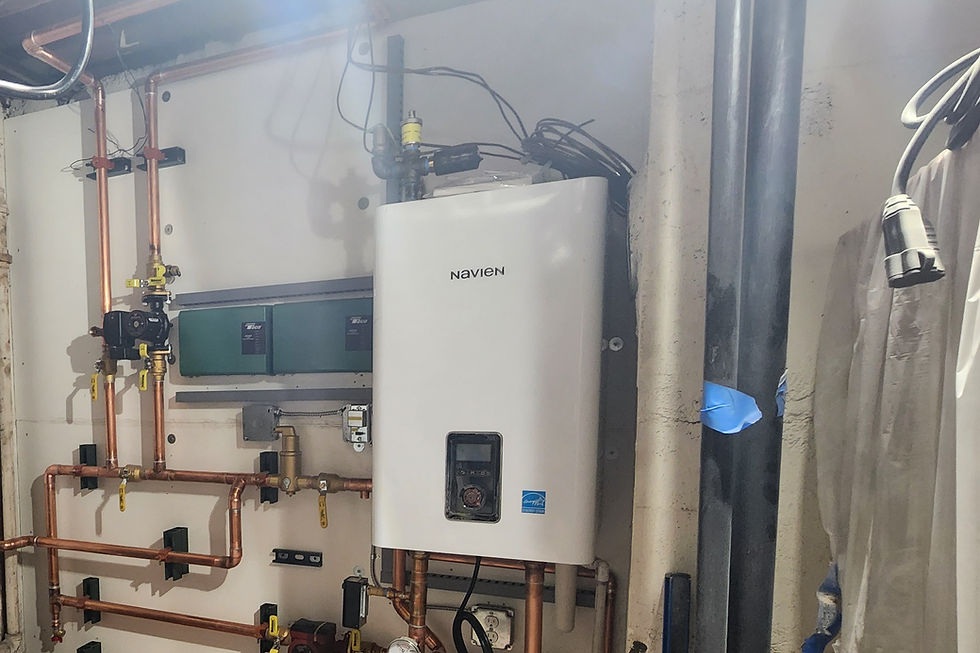
The slab is tubing, insulation, and mesh — well understood and straightforward to install once the design is right. The plant is where the project lives: a heat source sized to a load that may exceed the house, glycol for the exterior loops, a heat exchanger separating that glycol from the house side, dedicated circulators, expansion and fill for a second fluid volume, and controls that protect the boiler from a shot of very cold return water when a frozen slab first calls. Space, gas capacity, venting, and combustion air all have to accommodate it. This is one of the few places in hydronics where a genuinely large number is correct — unlike the routine oversizing that dogs boiler replacements, where the number was inherited rather than calculated. It still has to be calculated.
Whether the plant shares equipment with the house heating or stands on its own is the first design conversation, not the last. Our boiler and snowmelt pages cover how those pieces fit together.
What has to be right before the pour?
Tubing goes in before the concrete pour — there is no retrofit into existing concrete. Base scope includes under-slab insulation and 6x6 W1.4 mesh furnished and installed, both of which matter more on this ground than on flat lots: insulation because heat driven into cold rocky subgrade never reaches the surface, mesh because tubing has to stay where it was placed while a truck discharges onto it.
Loops go on 100 psi air, held through the pour, gauge visible. If a loop gets nicked by a boot or a rake, the gauge tells you while the concrete is still workable. After the pour, it tells you nothing you can act on.
The practical consequence is scheduling: this is summer and fall work, planned around the concrete, not bought in January. That is why heated driveways get installed in summer. The same discipline governs interior radiant floor heating, where tube depth is permanent once the concrete sets.
When is the honest answer something else?
Sometimes it is. The driveway is long enough that heating a useful portion of it means a larger heat plant than the property can support. The concrete is sound with twenty years left in it, and tearing out good pavement to bury tubing is hard to justify — better to plan the system for whenever that concrete comes due. The problem is really one bad forty-foot pitch, and heating that pitch alone solves it. Or the site would be better served by regrading, drainage, or parking closer to the road.
Snowmelt is a substantial undertaking. Choose it because the access problem justifies it, not because the driveway was on a list of upgrades. If yours does not need it, that is a fine outcome and we will tell you.
Where do you work?
We are a hydronics-only contractor working Morrison and the surrounding Jefferson County foothills, along with the rest of the south and west metro from a base in Littleton. Boilers, radiant, snowmelt, and mechanical room design — that is the whole list, and the full scope is on our services page. The Town of Morrison permits work inside town limits, and the surrounding unincorporated foothills permit through Jefferson County.
Older stone construction in the historic town core and newer houses up on the ridges are different heating problems, and both are worth a conversation first. Call (303) 908-5658 or reach us through the contact page.
Related reading
— Ryan Van Inwegen, licensed hydronic contractor (LIC00254926), ByDesign Hydronics & Air, Littleton, CO


Comments