Hydronic Heating in Greenwood Village, CO — One Boiler, Four Loads

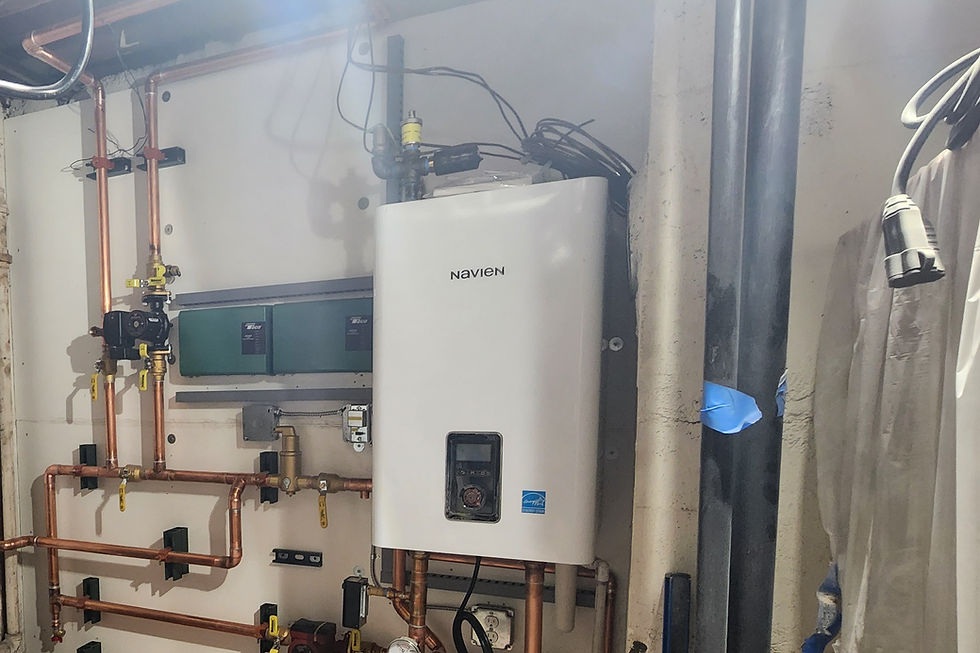
If one mechanical room is being asked to serve radiant floors, baseboard or air handlers, domestic hot water, and maybe a driveway, the boiler on the wall is rarely what's wrong. The piping arrangement and the control strategy in front of it are. Those four loads each want a different water temperature, on a different schedule, with a different urgency — and no single supply temperature makes all four happy.
So the honest answer, before you scroll: you almost certainly do not need a bigger boiler. You need the loads hydraulically separated, the low-temperature loads mixed down instead of run at whatever the high-temperature load demands, domestic hot water given a real priority, and a control that lowers water temperature as the weather warms. Get those four right and modest equipment performs beautifully. Get them wrong and no amount of capacity rescues it. Call (303) 908-5658 or tell us what your system is doing.
Why do larger Greenwood Village homes end up with four loads on one boiler?
Greenwood Village sits at about 5,500 feet in Arapahoe County, south of Denver and adjacent to the Denver Tech Center, and its residential lots are large by metro standards. Big lots produce big houses, long drives, and — over decades — additions. The housing runs from substantial 1970s and 1980s homes on acreage through recent custom construction, and both ends of that range arrive at the same place: several distinct heating loads and a lot of zones under one roof.
On the older houses it happens by accumulation. Baseboard heats the original core, a finished lower level gets radiant, a bonus room over a garage gets a small air handler because there was nowhere to put fin-tube, somebody adds an indirect water heater. Each piece was reasonable the day it went in, and nobody went back and asked what the whole assembly now needs. On newer custom builds it happens all at once by design — radiant on the main floor, panel radiators or air handlers where radiant wasn't an option, an indirect tank sized for a lot of bathrooms, heated concrete outside. Same result: one heat plant, four jobs.
Why can't everything just run off one supply temperature?
Because the loads disagree, and the disagreement isn't small. A radiant slab wants low water — often well under 120°F, depending on floor covering and how deep the tube sits in the pour. Fin-tube baseboard and older cast iron were sized around 180°F and can't deliver rated output down where radiant lives. A hydronic air handler wants high water to hold coil capacity. An indirect water heater wants the hottest water the boiler makes, so it recovers fast.
Run everything at 180°F and the radiant floor gets uncomfortable, assuming the slab tolerates it at all — some floor assemblies do not. Run everything at 120°F and the baseboard goes cold and the air handler blows lukewarm. There is no compromise number. The system has to make more than one temperature at once.
How do you actually make two temperatures at once?
You decouple the boiler from the distribution, then mix down for the loads that want it cooler. Hydraulic separation is the foundation — closely spaced tees, a hydraulic separator, or properly piped primary/secondary. The boiler gets the flow it needs, each load circuit gets the flow *it* needs, and zones stop stealing flow from one another when they come on together.
From there the low-temperature loads get mixed. A thermostatic or motorized mixing valve blends return water back into supply to hit a target. Injection mixing meters a small amount of hot boiler water into a cooler loop instead, which gives finer control and is usually the better answer on a large slab. Either way the principle holds: the boiler makes high temperature, and anything wanting lower gets it made locally.
This is the part that gets skipped. A boiler swap onto the old piping inherits every mixing problem the old system had, and the new equipment gets blamed for it.
What happens when the driveway and the shower ask at the same moment?
Snowmelt is the load that breaks systems that were never designed as systems. At the reference condition of 5°F air, 10 mph wind, and a 38°F surface, the Uponor Snow & Ice Melting Manual puts the slab load at roughly 126 BTU/hr/ft² — and on the kind of drive that comes with a large Greenwood Village lot, that multiplies fast. It also arrives unannounced, at whatever hour it starts snowing.
Now put a shower on top of it. Without a control strategy the boiler serves both badly: the driveway stalls out and the hot water sags. The fix is priority, and it has to be deliberate. Domestic hot water gets hard priority — when the tank calls, space heating and snowmelt stand down for the few minutes recovery takes, and nobody notices, because a well-insulated slab doesn't cool measurably in ten minutes. Snowmelt gets its own tier and often its own staging logic, so it idles at a lower temperature between events instead of demanding full output from a standing start. If you're adding a heated drive to an existing house, that conversation happens before anyone orders equipment.
Isn't more capacity the safe answer?
No. Oversizing is endemic in the metro — most replacement boilers here are two to three times larger than the building needs, and we've written about why that keeps compounding — and on a multi-load house the penalty is worse than on a simple one.
What matters is turndown: the ratio between the boiler's maximum and minimum firing rate. A house that needs full fire on design day spends most of the winter needing a fraction of it. If the smallest the boiler can fire still exceeds the load, it fires, satisfies, and shuts off, over and over. Short cycling wears ignition components, wastes fuel at every startup, and — because the boiler never runs long enough to settle into a low return temperature — quietly costs efficiency.
Two smaller boilers staged together often beat one large one here. Stage one alone covers the mild-weather load with room to modulate, both together cover design day plus snowmelt, and a failure doesn't leave the house cold. At about 5,500 feet, combustion equipment also loses capacity to thin air, and manufacturers publish derate tables for it. That derate gets applied once — not zero times, and not twice on top of a room-by-room heat loss that was already padded.
What is outdoor reset, and why does it matter so much here?
Outdoor reset lowers the boiler's supply temperature as the outdoor temperature rises. It's the highest-value control on the system, and it is routinely left unconfigured.
A system without reset makes design-temperature water on a 45°F afternoon. The emitters are wildly overpowered for the load, so zones satisfy in minutes and shut down, the boiler cycles, and return water never has time to drop. Rooms overshoot, drift, overshoot again — the "it's either too hot or too cold" complaint usually traces back here. With reset, mild weather makes mild water, run times get long, and return water spends the shoulder seasons exactly where you want it.
Why does my condensing boiler never seem to condense?
The condensing range only opens up when water comes back to the boiler below about 130°F. Above that it runs closer to 85% — which means a condensing boiler that never condenses is an expensive non-condensing boiler.
On a multi-load house, the most common reason it never condenses is that one high-temperature load is dragging the return up for everything else. Let an air handler or baseboard zone dump its 160°F return into the common return, and the boiler sees a blended temperature well above the condensing threshold — even though the radiant zones beside it are sending water back at 95°F. The efficiency you paid for is being spent keeping one circuit warm.
The answer is arrangement, not equipment: keep the high-temperature loads from contaminating the low-temperature return, and let the boiler see the coldest water the house can give it. Sometimes that means accepting one zone will never be a condensing zone. That's a fine outcome — it just needs to be a decision instead of an accident.
Zone valves or zone circulators at this scale?
Both work. Zone valves are cheaper per zone, quieter, and simpler to add to, which suits houses with a lot of small zones. They need a properly sized variable-speed circulator ahead of them, or the last zone to open gets starved.
Zone circulators give each load its own flow, which is genuinely better when the loads are very different — a large slab and a small air handler, say. The cost is more moving parts and more electricity. Permanent-magnet circulators also pull magnetite, the black iron-oxide sludge that comes off steel in every hydronic system, straight onto the rotor; ADEY reports roughly 70% of circulators returned to manufacturers fail on water-quality issues. More circulators means more of those, so water quality stops being optional.
On most large houses here the answer is a hybrid: circulators for the big, hydraulically distinct loads, valves for the clusters of small zones behind them.
Do I actually need a buffer tank?
Sometimes. A buffer tank adds thermal mass between boiler and loads, which stops short cycling when the smallest zone is smaller than the boiler's minimum output. If one 40-square-foot bathroom zone calls on its own, that tank is the difference between a boiler that runs and a boiler that machine-guns.
If your zones are reasonably sized, the boiler has good turndown, and the system already holds decent volume, a buffer tank is just floor space. We'd rather fix the sizing and the zoning first and see whether the problem survives.
What should I do about an older house that's been added onto?
Start with measurement, not equipment. A room-by-room heat loss tells you what each zone actually needs — whether a slab can run cooler, whether the baseboard is oversized enough to allow lower water, and whether the boiler is the wrong size or just badly controlled.
Then look at the piping. On a lot of these houses the equipment is fine and the arrangement is the problem — a mixing valve never commissioned, a reset curve at factory default, priority never set up, three circulators fighting over one header. All fixable without touching the boiler. We'll tell you what we find and what it would take to make it right, without a running commentary on whoever was there before. If the answer is "leave it alone and change these two settings," we'll tell you that too. Call (303) 908-5658 or describe what your system is doing.
Where do you work?
We're a hydronics-only shop based in Littleton, working throughout the south metro including Greenwood Village. Permits and inspections go through the City of Greenwood Village. Hydronics is all we do — boiler replacement and mechanical room design, radiant floor systems, and snowmelt. If we can't get to you in a reasonable window, we'll say so and point you elsewhere.
Related reading
— Ryan Van Inwegen, licensed hydronic contractor (LIC00254926), ByDesign Hydronics & Air, Littleton, CO


Comments