Your Boiler Has Two Pipes. They Tell You Almost Everything.

Updated: Oct 15
Most no-heat calls I take in October start the same way — "the heat isn't working." That one sentence covers about six completely different problems, and they don't get fixed the same way.
You can narrow it down yourself in five minutes, with your hand.
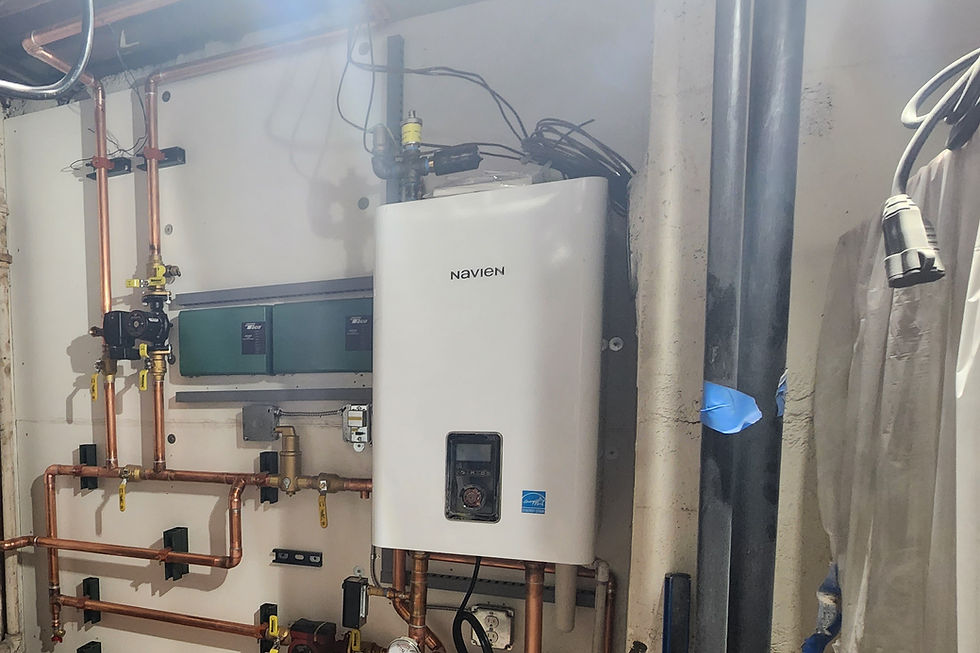
There are two pipes at the boiler: one carrying hot water out to the house, one bringing it back. The difference between them is the most useful number in a hydronic system. It tells you whether the boiler is making heat, whether the water is moving, and whether the heat is getting out of the pipe and into the room.
What should I do before I touch anything?
The supply pipe can be 180°F. Don't grab it. Touch the back of your hand to it briefly, or use a cheap infrared thermometer — about twenty dollars, and it turns this whole exercise into actual numbers instead of impressions.
Then give it five full minutes. Turn a thermostat up until the boiler fires, then leave it alone. A system waking up after six months looks broken for the first ninety seconds no matter what is wrong with it — or isn't. Half of what gets described to me on the phone is a cold start, not a fault.
While you're waiting, look at the pressure gauge. On a house up to three stories, it should read at least 12 psi cold. Below that, water isn't reliably reaching the top of the system, and the top floor is where you'll feel it first. A gauge sitting at zero is the one to call about rather than investigate.

What do the two pipes actually tell me?
After five minutes of running, put a hand near each pipe at the boiler. You'll have one of these six.
Nothing fires. No flame, no fan, no noise. The boiler isn't being asked to run, or it can't. Thermostat, power, a switch someone flipped, or a lockout code on the display. The pipes tell you nothing here, because nothing is happening.
Both pipes hot, clearly different, rooms warming up. Normal. Go back inside.
Both pipes hot and nearly the same, radiators or floors cold. No flow. The boiler is heating the same small slug of water over and over because nothing is pushing it out to the house — a dead circulator, a valve closed last spring, or a blockage. The boiler feels fine and the house is freezing, which is exactly why this one gets blamed on the boiler.
A big difference, return noticeably cold, far end of the house cold. Not enough flow. Water is moving, just too slowly, so it gives up all its heat before it gets anywhere. A worn circulator, a partly closed valve, a plugged strainer, or air in the loop.
A small difference, both pipes hot, room still won't come up. The heat is circulating fine and it can't get out of the pipe into the room. Fin-tube baseboard packed with dust and pet hair, or with the damper closed, or with a couch in front of it. A heated floor under a thick rug. A fan coil whose fan isn't running. This is the most common one in an older house, and usually the cheapest to fix.
Both pipes cool, and it never satisfies. Either it's still a cold start, or the boiler is genuinely underfired or overwhelmed — a fouled heat exchanger, a gas supply problem, or a plant too small for what it's being asked to do. Still cool after a long run on a cold day is a service call.

How big should the difference between the pipes be?
On most residential boilers the out-and-back difference lands somewhere between about 15 and 40°F. I start looking hard at flow when it runs past about 25°F while the boiler is up at full design temperature.
Two honest caveats on that number. Panel radiators and air handlers are often designed to run a 25–30°F difference on purpose — that isn't a fault. And on a system with outdoor reset, the difference shrinks naturally in mild weather, because the boiler is deliberately running cooler water. I wrote about that side of it in why your boiler shouldn't run one water temperature all winter.

What is the boiler telling me with noise?
A boiler that moans — a low rolling noise, a bit like a whale — paired with a pipe-to-pipe difference well above where it should sit is almost always scale or low flow. Water is boiling against the heat exchanger because not enough of it is moving through.
A sharp snap-crackle-pop at startup is the same story one stage further along: water flashing to steam inside a layer of scale. Neither one fixes itself, and both get more expensive the longer they run.
Gurgling is different. That's usually just air, and it often only needs purging.
Is a boiler that never reaches its setpoint broken?
Usually not.
A hydronic system settles where the heat the radiators give off equals the heat the boiler puts in. That settling point is set mostly by how much radiation is on the loop — not by the number on the aquastat. A house with generous baseboard will level out well below its setpoint and heat perfectly well. That's the system working, not failing, and chasing it with a higher setpoint usually just makes the boiler cycle more.
Why bother doing this before calling someone?
You don't have to fix any of these yourself. The point is that "the heat isn't working" and "both pipes are hot and the baseboard is cold" are different sentences, and the second one gets you a much better answer from whoever you call — including a more accurate price, because half the diagnosis is already done.
If you run the check and something doesn't look right, or you'd rather someone else put eyes on it, tell me what you found — which of the six you've got, and what the house is doing. Site visits are free, and I'll tell you what I find whether or not there's work in it for me.
Ryan Van Inwegen · ByDesign Hydronics & Air · Littleton, Colorado · Jefferson County Class A Master Mechanical license 1044527


Comments