Old Radiators in Golden, CO: Restore Them or Rip Them Out?

You called about the boiler and were told the whole system should go — radiators, pipes, all of it — replaced with a furnace and ductwork. In most of Golden's older masonry houses that is the wrong call. The radiators are usually the healthiest thing in the building. The boiler wore out, and that's a different job.
The question is never whether the radiators are old. It's whether they can deliver this house's heat at a water temperature a modern boiler wants to run — a measured answer, not an assumed one. Sometimes it's no, and even then there are ways to add capacity that cost and destroy less than cutting plaster for ducts. Call (303) 908-5658 or tell us what the house is doing.
Why does a cast iron radiator outlive three boilers?
Because there's nothing in it to fail. No burner, no thin-walled heat exchanger, no controls, no bearings, no fins to bend or clog — just iron sections joined by push nipples and tie rods. The water side helps too: in a closed system the water goes anaerobic and the iron stabilizes as a dark oxide film instead of eating itself as red rust.
The failures that do happen are mechanical and local — a weeping valve stem, a seep at a push nipple, a section split by freezing. That is a component wanting attention once a generation, not one at the end of its life.
What actually goes wrong with a hundred-year-old radiator?
Four things, and three of them are cheap.
Valves. Packing dries out and weeps at the stem — that's a repack, not a new radiator. Just as common is a valve someone throttled halfway decades ago and nobody reopened, which starves that radiator.
Air. Cold at the top, hot at the bottom, is air. A ten-section radiator with four sections of trapped air is a six-section radiator. Bleeding takes a key and a rag; what matters is why it comes back — fill water making up a leak, a circulator pulling air in, a dead vent.
Sludge. Hot at the top and cold along the bottom is the reverse: magnetite lying in the bottom of the sections, or a return elbow packed with it. Magnetite (Fe₃O₄) sheds off every iron surface in a wet system, down to about five microns; per ADEY, roughly 70% of circulators returned to manufacturers fail on water quality. Healthy water is slightly gray with a faint metallic smell. If the drain runs black and gritty, you have a water problem before you have a radiator problem.
Partial blockage. A valve disc that dropped off its stem, or a return riser choked at a fitting. A surface thermometer on each radiator's supply and return, while the system runs, shows which emitters work and which are pretending.
What about the radiator somebody painted silver?
That's the one paint problem that matters. A radiator does much of its work by radiation, and radiation depends on the emissivity of the surface facing the room. Metal flake is a poor emitter, so aluminum or bronze "radiator paint" costs you real output. Ordinary paint barely registers by comparison — and you don't have to strip anything, because painting over the metallic coating with a flat, non-metallic finish recovers most of the loss. If you want bare iron instead, do that with the radiator out of the house — paint of that era is likely lead-bearing.
Can the radiators I already have heat the house at a lower water temperature?
This is the whole question; everything else here is downstream of it.
The old system was designed around water near 180°F. A condensing boiler only condenses when return water is below about 130°F; above that it runs around 85%. Radiators sized for 180°F can't produce rated output at the 120–140°F a mod-con prefers. True, and exactly where the conversation usually stops.
It shouldn't. "Can't produce rated output" is not "can't heat the room." Rated output is capacity; what matters is the room's requirement. The original sizing was generous — picked for a house with no insulation and single glazing — and the house has been worked on since. The load came down; the iron didn't.
Golden's older core adds something frame neighborhoods don't have. Brick and stone walls carry real thermal mass: they respond slowly and want steady input rather than a fast hot recovery, which is exactly what a condensing boiler wants to give — and those radiators were sized to that behavior to begin with. A tight newer house on the mesas with a wall of glass can be a harder low-temperature candidate than a small brick house downtown with cast iron under every window.
How do you find that out instead of guessing?
By counting. Three steps.
Room-by-room heat loss on the actual house. Not a rule of thumb, and never the old boiler's nameplate. On the Front Range, newer tight construction lands near 25 BTU/hr/ft² and older brick with some weatherization near 40. Downtown Golden is the second number, and it moves room to room.
Inventory the emitters. Every radiator measured and identified: column, tube or thin-tube, height, section count, tubes per section. That gives a rated surface for each, and an output at any water temperature.
Compare per room and find the break point. Output falls off faster than proportionally as water temperature drops — losing twenty degrees costs more than twenty percent. What you want is the lowest supply temperature at which every room still makes it on the coldest day. The house has one such number, usually neither 180 nor 120, and somewhere in between still condenses most of a season under honest reset. It also sets how small the new boiler can be — most replacements here land two to three times larger than the building needs.
There's a free version of that test: turn the existing boiler's supply temperature down on a cold day and see which rooms fall behind. Usually it's one room, usually the one with the smallest radiator.
What if the emitters come up short?
You add surface. You almost never start over. Sections can be added to an existing radiator — rebuilders sell salvaged matching sections, so a ten-section radiator becomes a fourteen-section one. A second cast iron radiator can go in the room that failed. A modern steel panel puts a lot of output on a short run of wall and is built for low-temperature water. If a floor is coming up anyway, one room of radiant floor is a strong low-temperature emitter — not a warm-floor amenity, a floor that heats a room.
In the old core the binding constraint is wall space, not budget: narrow lots, small rooms, windows eating the perimeter. And a radiator sits under a window because that's where the cold downdraft off the glass lands.
Is it worth pulling a radiator to get the floor space back?
Sometimes — just be clear about the trade. Take a radiator out and that room loses the capacity permanently; the rest of the system doesn't pick it up. The room runs cold, the thermostat elsewhere stays satisfied, and somebody ends up with a space heater. Replace the surface in that same room.
What does the restoration work actually involve?
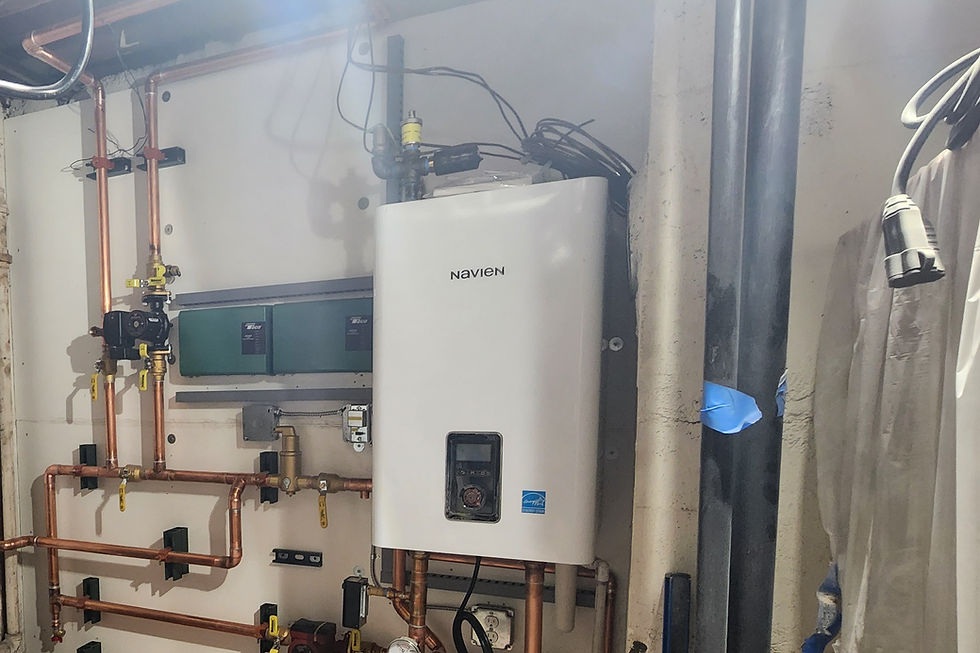
Clean the system properly — a real flush, a dirt and magnetic separator left in place, treated water, a water test rather than a hope. Rebuild the valves that need it, add balancing, sort the venting. Repipe near the boiler so the new appliance gets the flow and return temperature it was designed around — that's where most conversions are won or lost. Then run outdoor reset instead of one fixed temperature. And if the house has the fat mains of an old gravity conversion, that's an advantage at low temperature.
Golden runs its own building department, so permits and inspections go through the City of Golden rather than Jefferson County. Parts of the older core also sit under a historic preservation overlay, where exterior work can require additional review. Interior mechanical work is generally a separate question, but a sealed-combustion boiler replacement needs a vent terminal outside — settle that route early, not after it lands on a street elevation.
Altitude belongs in the same conversation. Golden sits at about 5,675 feet where Clear Creek comes out of the canyon, and houses up Lookout Mountain and toward Golden Gate Canyon sit well above 7,000 feet. Combustion equipment loses capacity in thin air and manufacturers publish derate tables — apply the derate once, not zero times and not twice. And if the old boiler shared a masonry chimney with the gas water heater, that venting has to be reworked.
When is forced air actually the right answer?
There are honest cases. If the distribution itself is gone — mains buried in a slab and leaking, piping nobody can reach — the comparison changes. And if you want central air badly enough to pay for ductwork, that's a legitimate preference.
What doesn't hold up in Golden's masonry core is the claim that ducts are the cheap way out. In a small brick house with plaster on masonry, small rooms and no interior chases, the ductwork has to go somewhere: soffits in most rooms, a furred chase down a corner, a closet surrendered on each floor. And you lose what radiators are quietly good at — no moving air, no dust, no noise. We do hydronics only, so if forced air is right for your house we'll say so and you'll hire somebody else.
What if the house has one-pipe steam?
Different animal, different rules, and the standard mistake is treating it like hot water with extra steps. The boiler boils, steam rises through the same pipe the condensate drains back down, and vents let air out ahead of it. Everything follows from that. The supply valve is open or closed, never partway — throttle it and returning condensate fights incoming steam, and that's your banging. Vent the mains fast and the radiators slowly. And a steam boiler is sized to the connected radiation, not the building's heat loss — the one place in this trade where sizing to the emitters is right.
Converting steam to hot water is not casual. Every radiator would run full instead of part full, every valve and vent is the wrong device, and pitch that drained condensate will now trap air. It's a repipe, not a swap.
Where do you work?
ByDesign Hydronics & Air is a service-area contractor working out of Littleton — no storefront, no office in Golden. We cover Golden and the rest of the Front Range: boilers, old radiators and old distribution, radiant floor, and snowmelt.
If your radiators are cold at the top, cold along the bottom, or somebody has told you the whole system has to come out, call (303) 908-5658 or start with the contact page. If the answer is to leave most of it alone, that's what we'll say.
Related reading
— Ryan Van Inwegen, licensed hydronic contractor (LIC00254926), ByDesign Hydronics & Air, Littleton, CO


Comments