Hot Water in Cherry Hills Village: Why a Bigger Tank Won't Fix It

If the shower at the far end of the house takes ninety seconds to run warm, and every answer so far has been a bigger water heater, the bigger water heater will not fix it. That wait is a distribution problem. The water standing in the pipe between the tank and that fixture went cold hours ago, and all of it goes down the drain before anything hot arrives. A tank twice the size holds twice as much water that is still eighty feet away.
A shower that runs hot twelve minutes then goes cold is a different failure from two showers where the second turns lukewarm: one is how much hot water you have, the other is how fast you make it. In houses the size of the ones in Cherry Hills Village — big footprints on big lots, mechanical space a long way from the fixtures — sorting out which of the three complaints you have is most of the job. Call (303) 908-5658 or tell us what the house is doing.
Is your problem how much hot water you have, or how fast you make it?
Capacity is stored volume: gallons already hot, ready to leave. Recovery is production: gallons per hour the burner or heat exchanger can raise through a given temperature rise. Big capacity with slow recovery gives you a fine twenty minutes and then a long wait.
Listen to what the house does. If hot water ends abruptly and does not return for forty minutes, recovery is the constraint. If it ends only when three fixtures are open and returns as soon as two close, stored volume is.
First-hour rating blurs the two: it is stored volume plus one hour of recovery, measured from a fully heated tank under a steady draw — conditions you get about once a day. Count what the house can open at once at real flow rates instead. Modern fixtures do not behave like the ones the plumbing code was written around: a rain head with body sprays can outflow two conventional showers.
Why does an indirect tank recover faster than a bigger gas water heater?
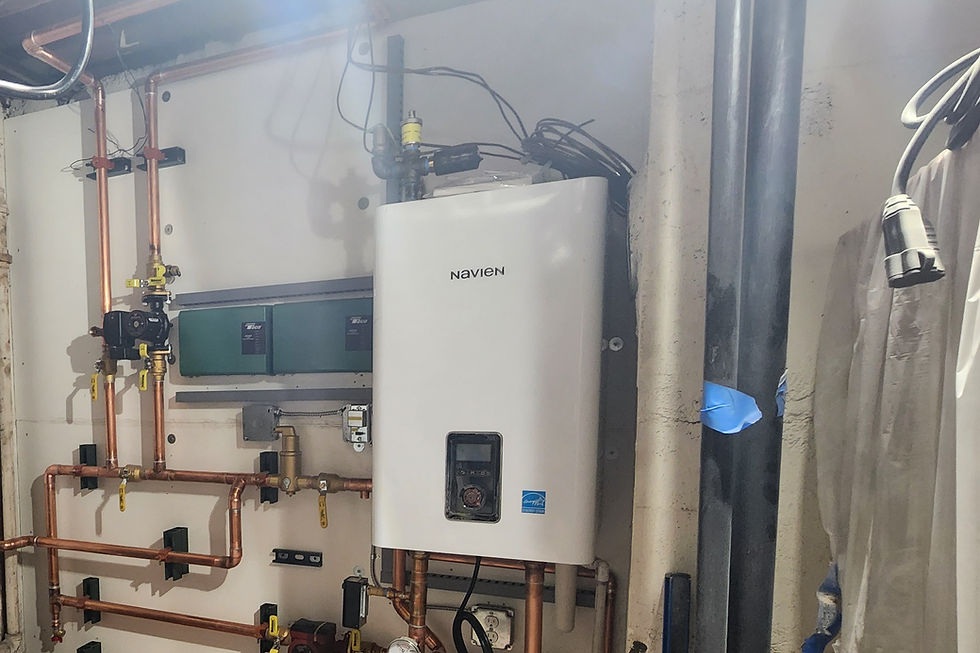
An indirect-fired tank has no burner and no flue of its own. It is an insulated storage tank with a heat exchanger inside — a coil, or a tank within a tank — and boiler water circulating through it heats the domestic water around it. The boiler does the work, and the whole advantage is on the recovery side. A standalone residential gas water heater might carry a burner around 40,000 BTU/hr; the boiler heating a large house is a far bigger appliance, and when the tank calls, most of its output goes at the domestic water. Recovery is BTUs per hour delivered, so an indirect on a matched boiler refills several times faster than a standalone tank of the same volume. It is the answer to the back-to-back-showers complaint. Plenty of boilers here are two to three times larger than the building needs, and hot water is the one load that surplus is good for.
What does hot water priority do to the rest of the house?
When the indirect calls, the control normally gives it priority: space heating zones drop out and everything the boiler makes goes to the domestic coil. That is what makes the recovery numbers real, and it also means the house stops being heated while somebody fills a tub.
Usually that is invisible — a radiant slab has the mass to coast twenty minutes without the room moving, though fast-responding emitters in a small zone are less forgiving. Any decent control carries a priority timeout, often half an hour to an hour, after which heat returns whether the tank is satisfied or not; disable it and a heavy morning holds heat off the house long enough to feel. Priority is also where an undersized boiler and a generous indirect fight each other, which is why they get sized together, off a real room-by-room heat loss.
Why does the far bathroom run cold for ninety seconds?
Because the pipe is full of cold water and you have to move all of it first. Three-quarter-inch copper holds roughly a gallon for every forty feet of run, so a hundred-foot trunk out to a far bathroom is about two and a half gallons standing in the line. At a couple of gallons a minute, that is over a minute of waiting, every time, forever — three draws a day is roughly 2,700 gallons a year down the drain before anyone washed anything.
That is the penalty of building on very large lots. When land lets a house spread out instead of stack up, the plumbing spreads with it: long horizontal runs, and a mechanical room that landed wherever there was space rather than near the load it serves. Remodeling compounds it — a new primary suite or a finished upper level puts bathrooms at the end of a run that was already long, fed by a layout drawn for the original house.
What does a recirculation loop do, and when is it worse than nothing?
A loop keeps hot water moving in the trunk so it is there when you open the tap: a small pump pushes it out the hot main and back to the tank on a dedicated return. Done right, the wait drops to the length of the fixture's own branch, so where you land the loop matters. A loop that stops sixty feet short of the bathroom you were complaining about has solved someone else's problem.
Done wrong it is worse than no loop. A pump running continuously through uninsulated copper turns two hundred feet of trunk into a heat emitter. The pipe sheds heat into the basement ceiling, the tank cools, the tank calls, the boiler fires — around the clock, in July, to warm a crawlspace.
Two smaller failure modes: overpumped loops erode copper and leak at elbows, so keep velocity low; and a potable loop needs a bronze or stainless pump, not the cast iron that belongs on the heating side, where sludge is the enemy.
Timer, aquastat, or demand control — which belongs on the loop?
A timer is the crudest control: the pump runs on a schedule and knows nothing else. An aquastat on the return is better — the pump runs until returning water hits setpoint, then stops until it drops. Paired with a timer it cuts run hours sharply, with no new wiring.
Demand control is the right answer in a house with long runs. A button or occupancy sensor at the far bathroom starts the pump; a sensor at the end of the loop stops it the instant hot water arrives. The pipe sits cold the rest of the day, so the standby loss that ruins continuous loops disappears. A low-voltage run or a wireless button at the point of use makes a remodel with open walls the cheapest time to do it.
Is tankless ever the right answer in a house like this?
Usually it is the wrong answer, and not because the technology is bad. Tankless is sized by flow at a temperature rise, not by volume. Incoming water is cold in January, so you are asking for a 70 to 80 degree rise, and a single residential unit tops out near 199,000 BTU/hr of input. At roughly 5,400 feet, combustion equipment loses capacity in thin air and the altitude derate comes off that number — applied once, not ignored and not counted twice. Covering several simultaneous draws means banked units, a bigger gas line, more vents.
It also does nothing for the ninety-second wait, and arguably worsens it: burner ramp time gets added to pipe travel time, and low-flow fixtures can fall under the minimum flow that fires the unit at all. Recirculating one takes a model built for it plus a buffer tank — a tank with extra steps.
Where it earns its place is a remote fixture group far from the mechanical room: a small dedicated heater for one distant bath or a detached structure, instead of a hundred feet of trunk recirculating forever.
Can storing hotter and mixing down buy capacity you already own?
Yes, and cheaply. Store at 140°F and deliver 120°F through a thermostatic mixing valve. Every gallon leaving the tank blends with cold on the way out, so fifty stored gallons becomes roughly sixty-four gallons delivered at 120°F — close to a third more usable water from the same tank and burner. It also keeps storage above the Legionella range and scald temperatures away from the fixtures. If you store hot, the mixing valve is not optional. The trade-off: hotter storage lays down scale faster.
What is the water doing to the inside of the tank?
Hardness precipitates on the hottest surface it touches. In a standalone gas tank that is the bottom, over the burner, where sediment builds into an insulating blanket — the popping people describe is water flashing to steam underneath it. Recovery falls and the bottom cooks.
In an indirect, scale plates onto the coil — and the coil is the whole reason you bought it. A fouled heat exchanger hands back the recovery advantage that made the indirect right. The maintenance is simple — flush on a schedule, check the anode rod on glass-lined tanks (stainless indirects have none), confirm the mixing valve still holds setpoint. It only has to be physically possible.
Can anyone actually get to the equipment to service it?
A mechanical room nobody can work in is a mechanical room that fails.
In houses remodeled repeatedly — and the village has plenty, spanning mid-century construction through recent custom builds — equipment ends up wherever finished space could spare it: behind a closet door, under a stair, in a room sized by the millwork. What disappears is service clearance. Room to pull a coil. Vertical space above the tank to withdraw an anode rod. A drain within reach of the flush port.
The rest is predictable: the flush never happens because it is genuinely difficult, scale builds, recovery degrades, and three years later the complaint is hot water and the answer proposed is a bigger heater. That is the difference between a system that gets maintained and one that only gets replaced.
One item that belongs elsewhere: a boiler leaving a shared masonry chimney can leave the gas water heater unable to draft — a venting question, not a hot water one.
Where do you work?
We are a hydronics-only contractor working out of Littleton, and Cherry Hills Village is well inside the service area. What we do covers the full scope, including radiant floor heating. There is no storefront and no office in the city. Permits and inspections go through the City of Cherry Hills Village.
If the complaint is a wait, a shortage, or a system that was fine before the addition, tell us what the house does and when. Call (303) 908-5658 or get in touch here.
Related reading
— Ryan Van Inwegen, licensed hydronic contractor (LIC00254926), ByDesign Hydronics & Air, Littleton, CO


Comments