Boiler & Radiant Heat in Evergreen, CO: Propane, Altitude, Outages

If the gas main stops somewhere down the hill from your house, you aren't solving the same heating problem the metro solves. You own the fuel. It arrives on a truck, sits in a tank on your property, and burns at a different energy content, through different orifices, at a different manifold pressure than the identical boiler burns in the valley. Get one of those wrong and the appliance still lights — it just runs badly, in a way nobody catches until the tank empties faster than it should.
The short answer for an Evergreen house: equipment selection is driven by fuel type, altitude derate, combustion air, and what happens when the power goes out — in that order — and everything gets sized against a room-by-room heat loss. Not the square footage, not the last boiler's nameplate. Natural gas service doesn't reach much of this area, a large share of homes run propane from an owned or leased tank, and elevation across Evergreen runs roughly 7,000 to 8,500 feet depending on where you sit.
What actually changes when the fuel is propane instead of natural gas?
More than most people expect. Propane carries far more energy per cubic foot than natural gas — roughly two and a half times as much — so for the same firing rate the burner passes much less gas volume. That means smaller orifices, or on a modulating boiler a different gas valve setting and a changed air-fuel ratio at the venturi. Manifold pressure differs too: propane appliances typically want around 10 to 11 inches of water column where natural gas wants about 3.5.
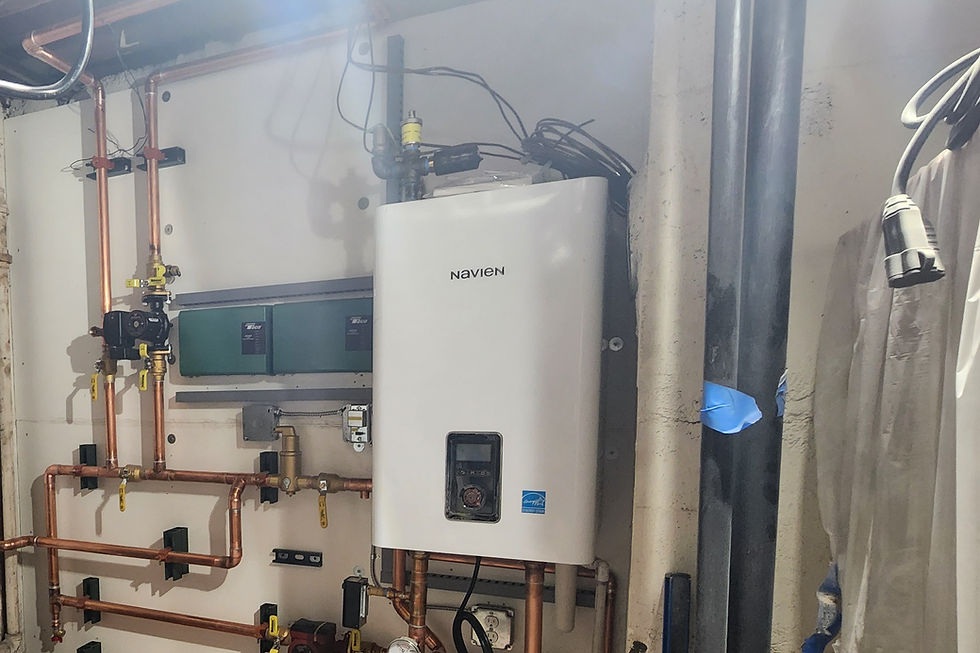
Most condensing boilers ship with a conversion kit and a documented procedure — swap the orifice or restrictor, change a parameter, then verify combustion with an analyzer at high fire and low fire. Verification is the part that gets skipped, and a conversion never measured is a guess with paperwork attached. Rich shows up as soot in the heat exchanger and a boiler losing output over a season; lean shows up as a flame that drops out on a cold morning when the vent is fighting wind.
Propane is heavier than air, so a leak settles into the lowest space it can find — which, in a house built into a hillside with a walk-out lower level, is exactly where the mechanical room usually is.
Why does the delivery truck change how the system gets designed?
Because on propane, efficiency stops being an abstraction and becomes a cash-flow question. In the metro it's a monthly line item. Here you buy a tank's worth at a time, and the difference between a boiler that condenses and one that doesn't is the difference between four fills a winter and five.
That changes what's worth doing. A condensing boiler only condenses when return water comes back below about 130°F. Above that it runs around 85% — a fine boiler, but not the boiler you paid for. So the design work goes into keeping return temperature low: distribution sized for lower water, outdoor reset that actually resets, no primary loop quietly mixing hot supply back into the return.
Tank sizing follows the same math. Tanks are filled to roughly 80% to leave vapor space, and vaporization rate depends on how much liquid touches the tank wall and how cold that wall is. A nearly empty tank on a bitter morning, boiler at full fire with a range and dryer running, can struggle to vaporize fast enough — pressure sags and the burner reads it as a fuel fault. Size for peak demand at low fill level, not average demand at half full.
What happens if the tank runs dry on a Sunday in January?
You find out how long your driveway is. That's the design constraint, not a joke. Driveways here are long, frequently unpaved and steep, and access in a storm decides when anyone can reach you at all — including the fuel truck. A dry tank isn't just an empty tank: it means a leak check and a relight before the system goes back in service, and that's a scheduled visit, not a same-hour one.
So we design backward from it: conservative tank sizing, a tank monitor somewhere the owner will actually look, and a heat plant whose seasonal burn is predictable enough that a fill schedule means something.
Worth talking through before you commit: (303) 908-5658, or send details through the contact page.
How does altitude derate actually work at 7,500 feet?
Air thins with elevation, so a given volume carries less oxygen, so a burner rated at sea level can't release its full input without going rich. Manufacturers publish altitude derate tables for exactly this.
The correction gets applied once. Not zero times, not twice. Zero is the obvious failure: the installed plant quietly makes less heat than the paperwork claims. Twice is the sneakier one: the manufacturer already publishes a listed input for the altitude band and someone derates it again "to be safe," or the derate is taken in equipment selection and taken a second time in the load calculation. Both are invisible at commissioning and both show up in February.
At Littleton's roughly 5,350 feet the correction is real but modest. Two thousand-plus feet higher it isn't, and it lands on a load that usually got estimated rather than calculated. That's why room-by-room heat loss matters more here, not less: a tight house up here can land near 25 BTU/hr/ft², an older leakier one closer to 40, and that number is what the derated output has to cover. Sizing off whatever was there before is how boilers end up two to three times larger than the building needs — and on propane that's a fuel bill, not just short cycling.
Where does a tight mountain house get its combustion air?
From somewhere, whether you planned it or not. A tight envelope with a range hood, a dryer, and a wood stove competing for the same air can pull the mechanical room negative — and at altitude the burner already has less margin before combustion goes wrong.
We prefer direct vent: sealed combustion, air drawn from outside through its own pipe, so the boiler isn't sharing an air budget with the house. Where there's a wood-burning appliance, and many houses here have one, that isolation matters more. Open combustion with an air opening sized on the assumption the room stays neutral depends on nobody running the stove and the dryer at once.
How do you vent a boiler on a house built into a hillside?
Carefully, with the manufacturer's tables in hand. Steep grade puts terminations close to the ground uphill and two stories up on the downhill side. Too close to grade and snow drifts over the termination — a vent buried in a drift locks the boiler out if you're lucky and spills if you're not. Snow clearance is a dimension, not a hope.
Long runs matter too. Every elbow costs equivalent length and total developed length is capped. Heavily treed lots and recirculation on the lee side can let flue gas find its own intake.
What happens to a hydronic system when the power goes out?
It stops. A hydronic system with no electricity is a system with no heat — the boiler won't fire without controls, and even if it could, the circulators aren't moving water. Outages here are more common and longer than on the plains, and if the driveway is drifted shut, the outage and the repair window are the same problem.
So freeze protection gets decided deliberately. Three honest paths. One: a properly sized generator with an automatic transfer switch, so boiler, circulators, and controls carry through. Two: glycol at a real concentration, tested and maintained — which costs some heat transfer capacity and some pump head, and means boiler and pumps get selected knowing it's there. Three: accept the risk on a house somebody lives in and can drain. Which is right depends on how often the house sits empty.
Either way the layout should assume a freeze is possible: no dead legs in unconditioned crawl space, no distribution buried in an exterior wall cavity because it was convenient, drain points where you'd need them.
How do you leave the house empty for three weeks without gambling?
A meaningful share of homes up here are second homes, or sit unoccupied for parts of the year. That one fact rewrites the control strategy.
Deep setback is a worse idea in a radiant house than a forced-air one. A slab has hours of thermal lag; drop it to 50°F for two weeks and it takes a long time and a lot of fuel to bring back, and that recovery lands when the boiler is least able to help. A modest setback that keeps the mass warm usually costs less than a deep one plus a hard recovery.
Remote monitoring is worth more here than anywhere else we work — not the thermostat as a gadget, the alarm layer. Low-temperature alert on the coldest zone, loss-of-power notification, tank level, a leak sensor on the mechanical room floor. Cheap against what they prevent, and they turn "the house froze sometime in the last eleven days" into a phone call while it's still fixable. A system left alone should be able to say something.
Does anything change about radiant floors and snowmelt up here?
The physics don't change; the constraints do. Radiant floor heating suits these houses — big glass, tall volumes, slab construction — but radiant floors are not warm floors, they're floors that heat a room. Tube depth is permanent: tube at the bottom of a 4" pour instead of mid-height raises required water temperature by roughly 7°F for the life of the building, and on propane you pay that every winter.
Snowmelt is a real conversation on a long steep driveway a plow can't do much with. It's also a heat plant with a driveway attached, and on propane the fuel question gets settled first, not last.
Whatever the distribution, the water in it matters — and on a well, with glycol in the mix, fill quality and a dirt separator aren't optional extras. Magnetite sludge collects on permanent-magnet rotors, and per ADEY roughly 70% of circulators returned to manufacturers fail on water-quality issues.
Who permits and inspects the work in Evergreen?
Evergreen is unincorporated, so permits and inspections go through Jefferson County.
Where do you work?
We're based in Littleton and work the Denver metro and the foothills, Evergreen included. Being straight about it: mountain work is scheduled differently than metro work. It's a long drive, weather closes the route, and a job up Bear Creek gets planned as a block of time rather than squeezed between two valley calls. That suits planned work — a boiler replacement, a mechanical room rebuild, a radiant install. If we can't get to you in a reasonable window, we'll tell you that up front rather than string you along, and we won't promise a response time we can't keep.
If you want the system looked at properly, call (303) 908-5658 or use the contact page. If the answer is "leave it alone," we'll tell you that too.
Related reading
— Ryan Van Inwegen, licensed hydronic contractor (LIC00254926), ByDesign Hydronics & Air, Littleton, CO


Comments