Don't Set Back a Radiant Floor at Night. Here's the Math.

Updated: Oct 9
Every fall I get the same question, usually from someone who just moved into a house with a heated slab. They want to know what to set the thermostat back to at night, the way they did with the furnace in their last house.
On a radiant floor, the answer is: don't. Pick a temperature and leave it there.
Here is why, in numbers you can check yourself.
A concrete slab is a battery
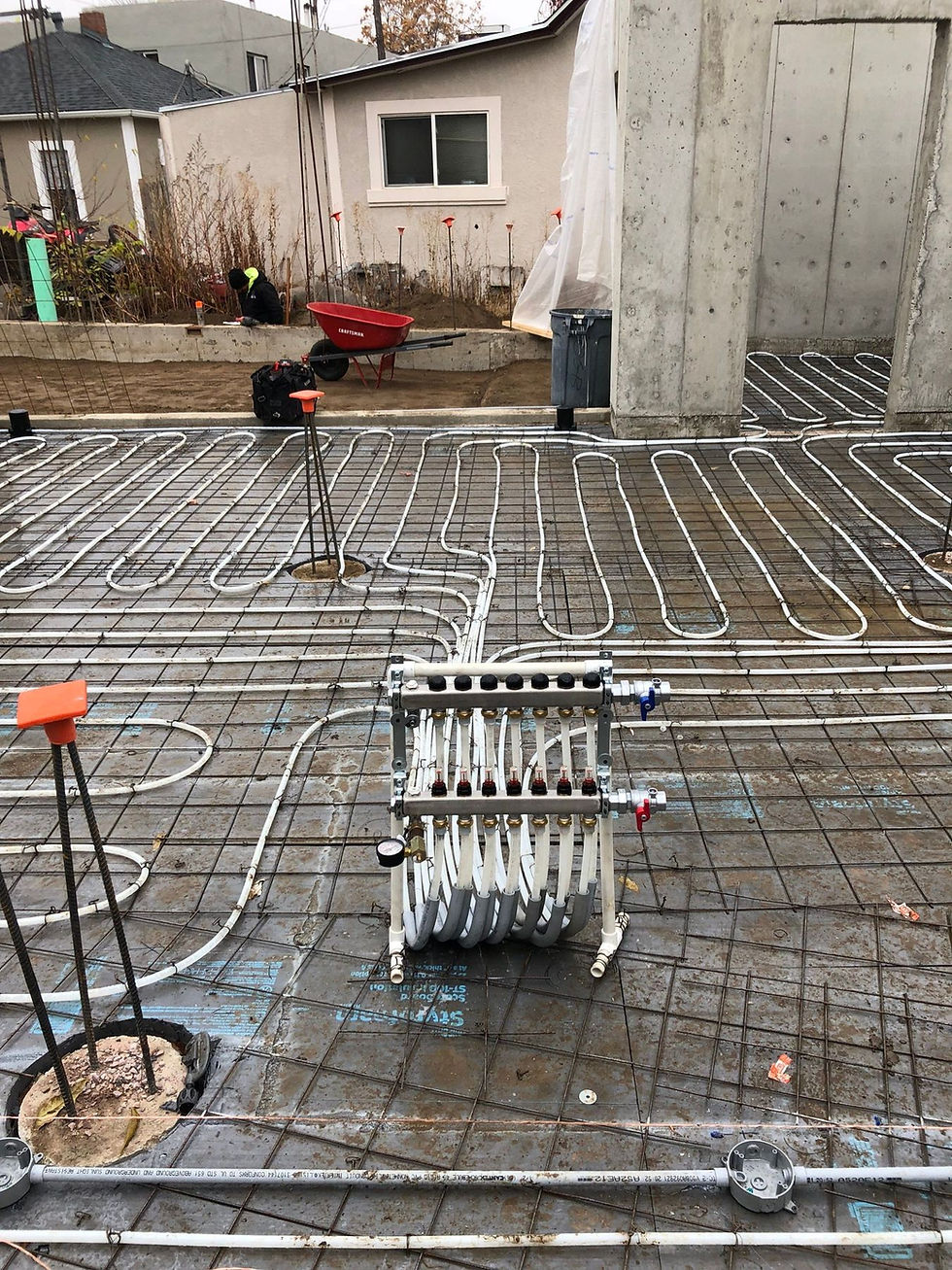
Forced air heats the air in a room. A radiant floor heats the slab, and the slab heats the room. That middle step is the whole story, because a slab holds a lot more heat than a room full of air does.
Run the arithmetic on a four-inch slab. One square foot of it is a third of a cubic foot of concrete. Normal-weight concrete runs around 145 pounds per cubic foot, so that square foot weighs about 48 pounds. The specific heat of concrete and most masonry is about 0.2 BTU per pound per degree. Multiply it out:
0.33 ft³ × 145 lb/ft³ × 0.2 BTU/lb·°F ≈ 10 BTU per square foot, per degree
So every degree you let a four-inch slab fall, you have to put roughly 10 BTU per square foot back in before the room feels the same again. Across a 1,000 square foot zone, a 3°F slab swing is about 30,000 BTU of stored heat you took out and now have to replace.
The air in that same room holds well under 1,000 BTU for the same 3°F. That is the difference, and it is roughly a factor of thirty.
You don't have the surplus to put it back quickly
Here is the part that catches people.
A radiant floor has a ceiling on how fast it can deliver heat, and the ceiling is set by how warm the floor surface is allowed to get. A floor gives up about 2 BTU/hr per square foot for every degree the surface sits above room temperature. In a living space you are held to somewhere around 81 to 84°F at the surface before the floor is uncomfortable to stand on. Against a 68°F room, that works out to about 30 BTU/hr per square foot, and that is the ceiling.
Front Range houses run a design heat loss somewhere between 25 and 40 BTU/hr per square foot depending on the era and how tight the shell is. Call a reasonably tight house 25.
On a cold morning that room is already pulling close to 25 just to hold temperature. The floor's ceiling is 30. The surplus available to re-warm the slab is around 5 BTU/hr per square foot — and you need about 30 BTU per square foot back.
30 ÷ 5 = 6 hours
That is a rough figure with the assumptions stated, not a promise about your house. But the order of magnitude is right, and it matches what people actually report: the slab is still catching up at lunchtime.
What you actually saved
A building loses heat roughly in proportion to the difference between inside and outside. Let the house drop 3°F for eight hours and yes, you save something. But the slab gives up its heat so slowly that the room never drops much in the first place. You collect a small fraction of what a forced-air setback would return, and you pay for it with a cold morning and a boiler running flat out to recover.
There is a second problem underneath that one. If your boiler runs outdoor reset — and it should — the control is deliberately supplying the lowest water temperature that will hold the house at the current outdoor temperature. There is no reserve built into that curve. A reset control and a deep setback spend the whole morning working against each other.
What to do instead
Pick one indoor temperature and hold it. On a high-mass system that is not a compromise, it is how the thing is designed to run.
If rooms are uneven — the living room at 74 while a bedroom sits at 65 — that is a zoning and balancing problem, not a scheduling problem. Setting the thermostat back at night will not fix it, and it usually makes the spread more obvious.
If part of your house is fin-tube baseboard, cast iron, or panel radiators, those respond much faster, and a modest setback on those zones is reasonable. The rule follows mass, not fuel: the heavier the emitter, the less sense a setback makes.
And if you have been shutting a slab zone off entirely through the shoulder season, bring it back up before you need it rather than on the first cold night. A slab that has been off for weeks takes a long time to come up the first time.
The one thing to check this month
On a day you have not touched the thermostat, put a thermometer on the floor in the morning and again in the evening. If the floor surface is swinging more than a couple of degrees, something is cycling that should not be, and the control is worth a look before the weather turns.
If you are still planning a heated floor, here is how radiant floor heating in Denver gets designed so it holds temperature without a setback.
If you want another set of eyes on how your system is set up, get in touch. Hydronics is all we do.


Comments